Observatory
A viewing deck for model behavior.
The observatory is the site's editorial engine. It asks how a phrase travels from research paper to product note, from product note to public debate, and from public debate into ordinary work. Language model concepts become confusing when they are treated as slogans. Here they are treated as exhibits: each one needs a viewing angle, a label, a nearby example, and a warning about what the label cannot prove.
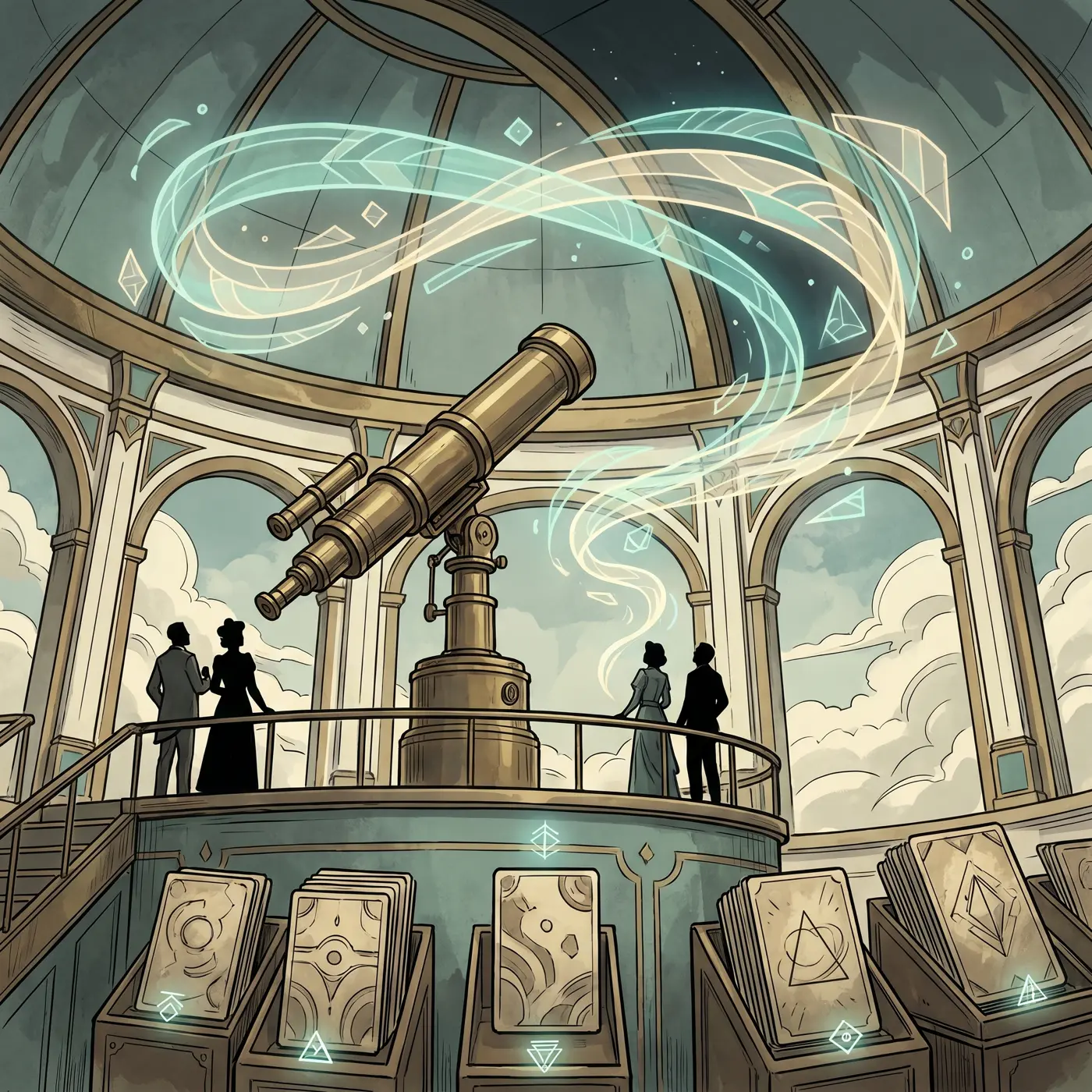
The floor is arranged by questions, not alphabet.
A visitor might arrive asking why an answer sounded confident but wrong, why a retrieval system quoted one document and missed another, or why an evaluation score improved while users still complained. Those questions belong together even when the terms come from different disciplines. LLMopedia groups concepts by the decision they help a reader make: how to phrase a task, how to supply evidence, how to judge an output, how to keep a record, and how to explain limits without hiding behind technical language.
This format deliberately avoids the feel of a static encyclopedia shelf. The site keeps the clarity of a reference work, but uses spatial cues, visual captions, and editorial notes so the reader can remember where a concept lives. A prompt is not just a definition; it is a doorway into instruction design. Grounding is not just a term; it is a viewing practice for checking whether a claim is attached to an inspectable source.
Viewing passes
Every exhibit passes through four checks.
Pass 1
Name the concept in plain language before naming products or vendors.
Pass 2
Locate the concept inside a workflow: prompt writing, retrieval, evaluation, governance, or publishing.
Pass 3
Separate the visible symptom from the hidden mechanism when the mechanism is uncertain.
Pass 4
Record the question a reader should ask before using the term in a meeting, brief, or article.